RCR arquitectes. Arrels i ales
Exhibition · Museu de la Garrotxa · Olot
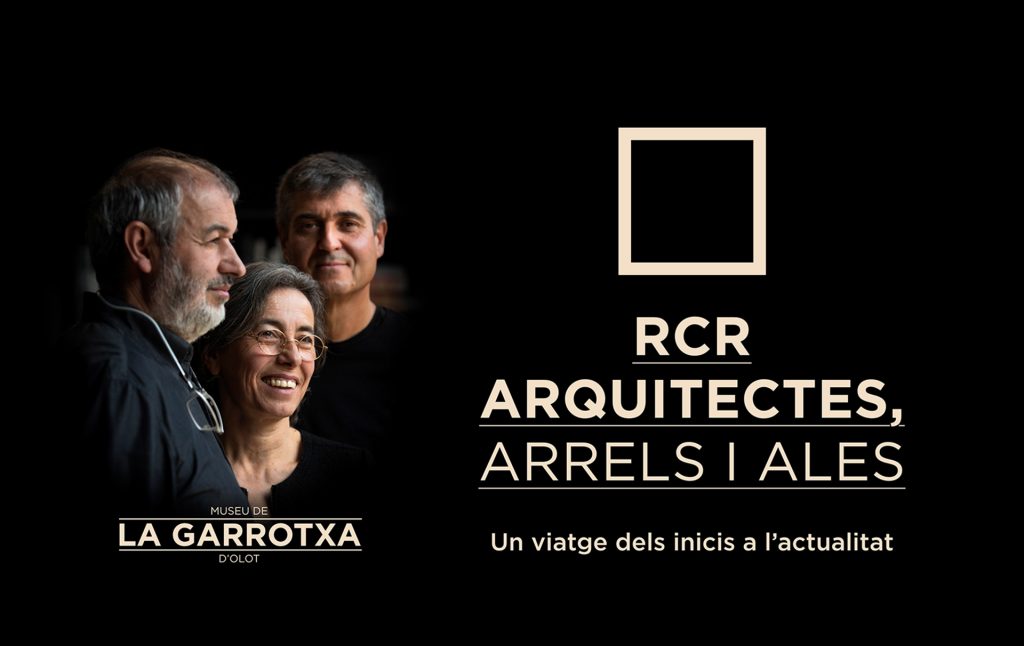
EXHIBITION · RCR Arquitectes: Roots and Wings. A journey from the beginnings to the present
The work, its relationship with the landscape, and the universal influence of RCR from La Garrotxa
Curator: Jaume Prat Ortells
La Garrotxa is on the global architecture map thanks to the drive of RCR arquitectes. For them, it is not just a place of residence. La Garrotxa is where they grew up, the culture that shaped them, and the context through which their work is understood. Rafael Aranda, Carme Pigem, and Ramon Vilalta studied architecture in Vallès, travelled to Japan, and brought those influences back to Olot, where they merged them with the local heritage to create the studio’s first works. After being awarded the Pritzker Prize in 2017—the Nobel Prize of Architecture—they reversed the flow of influence, exporting La Garrotxa to the world.
This journey through the studio’s history occupies the entire museum for the first time. A temporary exhibition room explores these local beginnings —the roots. The cloister, in dialogue with the permanent exhibition, reflects the relationship their body of work has established with local culture. A photographic display presents their connection with the landscape. Finally, the Sala Oberta presents their latest works and most recent projects: creative wings from a humanistic perspective that have made RCR arquitectes a global reference.
- Location: Museu de la Garrotxa
- Dates: 14 March – 9 August 2026
- Admission: free
- Opening hours:
Weekdays: 10 am – 1 pm and 5 pm – 8 pm
Saturday: 11 am – 2 pm and 5 pm – 8 pm
Sundays and public holidays: 11 am – 2 pm
Closed on Mondays
Guided tours by Jaume Prat Ortells, curator of the exhibition:
Saturday 11 April, at 12 pm
Saturday 16 May, at 12 pm
Saturday 20 June, at 12 pm
Sala Oberta 2 · RCR, Beginnings
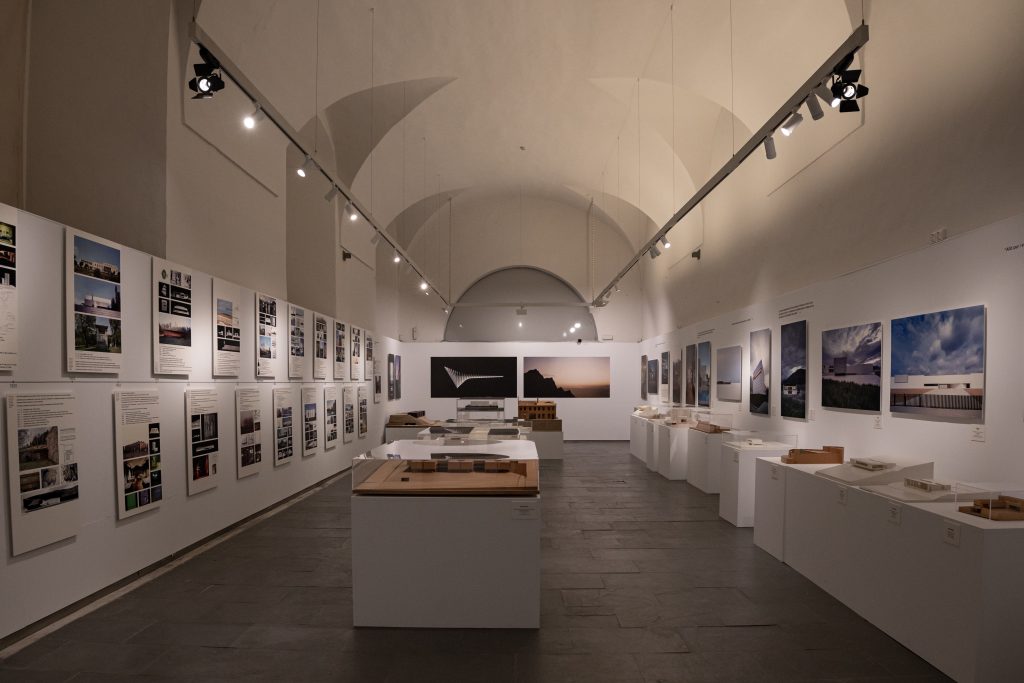
RCR, Beginnings: in Sala Oberta 2, the exhibition opens with the studio’s first works in Olot, exploring their decision to develop their practice from the city and their relationship with the landscape. It ranges from houses to transformative interventions from the studio’s first twenty years, such as the Margarida, Mirador, and Horizon houses—built laboratories in which to question conventional ways of living—as well as the Tossols-Basil Athletics Stadium, the Bath Pavilion, and the Pedra Tosca Park: local landscape interventions that enable the citizens of Olot to inhabit the Garrotxa Volcanic Zone Natural Park.
Beginnings
The beginnings of RCR Arquitectes are linked to an intense experimentation grounded in the landscape surrounding Olot. This natural park has been intensely shaped and inhabited, generating a landscape where nature and the artificial coexist in harmony. The Punta Aldea Lighthouse, in Gran Canaria (1988), won through a competition, would serve as a manifesto of this way of understanding landscape and architecture. In Olot, the Special Protection Plan for the Tossols-Basil area (1990) applies this sensitivity to bring the park even closer to citizens and to organise spaces for leisure and recreation. The Tossols-Basil Athletics Stadium and the Bathing Pavilion would be the result. At the same time, they propose a series of bold interventions that, without a pre-established formal imaginary, will strengthen their relationship with construction and industry and deliver results from the start.
The Imaginary City, the Torn City
The contemporary city—overbearing and colonising, seeking to conquer the territory—must be subordinated to the landscape and must be torn apart, broken; it must be traversed by green bands, fluid public spaces like a fluvial system, more suited to contemporary life, which will provide the city with a new order. This is to establish a new dialogue between ruptures and constructed fragments, and non-ruptures and landscape totalities, toward a new territorial future.
Because, ultimately, the imaginary city begins where the landscape continues.
Aranda – Pigem -Vilalta, associated architects
Artist of the Month, 1994
WHOEVER SPEAKS OF OLOT AND DOES NOT
KNOW IT, EVEN HAVING BEEN
INTRODUCED TO IT, HAS A VALUE
IMAGINED
WHOEVER KNOWS OLOT AS AN OLD
FRIEND, WITH A LONG
HISTORY, HAS A VALUE
WITHOUT IMAGE
WHOEVER WANTS TO MATERIALIZE OLOT
BY ADVANCING UPON ITS
IMAGINED VALUE, HAS A VALUE
IMAGINARY
WHOEVER WANTS TO CREATE AN IMAGE
BY COMBINING THE IMAGINED, THE IMAGELESS,
THE IMAGINARY, THIS IS THE PROPOSAL
Aranda – Pigem -Vilalta, associated architects
Artist of the Month, 1994
White Period
From the outset, the houses of RCR Arquitectes would be recognised for their marked and well-defined prismatic volumes, clad in limestone of a very pure whiteness from Cabra, Córdoba. These highly characteristic houses embody a strong spirit of experimentation: from the narrow bays running parallel to the terraces of the Mirador House in La Moixina, to the explicit use of steel in the House for a Blacksmith and a Hairdresser in La Canya. Each of these houses would continue to innovate, testing different aspects and ways of relating to both the landscape and their immediate surroundings.
The projects would grow in scale—Spaces for Leisure and Culture in Riudaura; the Vilartagues Secondary School in Sant Feliu de Guíxols; and the Faculty of Law of the University of Girona—and would diversify in function. This collection of houses constitutes a laboratory in which each piece finds its own personality and specific characteristics.
Barberí Space, the Paradigm
RCR’s studio, Barberí Space in Olot, is a place completely unlike conventional architecture studios, as Rafael Aranda, Carme Pigem, and Ramon Vilalta transformed the remains of an 18th-century bell foundry into a polyvalent, transparent, open space, where vegetation and landscape engage in dialogue with the workplaces, avoiding the cold austerity of white-walled architecture.
Thus, the old cast-iron columns, the trusses, the cranes, and the calcined walls house the tables with computers, shelves full of books, large boards with unfolded plans, and the drawings and watercolours scattered throughout. In fact, Barberí Space is a laboratory, in the manner of Warhol’s Factory—a place without human or intellectual boundaries where everything is at the service of creativity, imagination, and innovation.
Daniel Giralt-Miracle, text The Poetics of an Architecture.
“… And he dreams,
what does he dream?
Painters with the brush as great creators…”
2nd Literary Contest of 8th grade EGB: “An Angel Sleeps”, 1972
“What is pure and essential—the idea—is what matters!”
1988
“Our architecture has its origin in the environment in which we live and in who we are as people, and we are passionate about the global village, the time that makes us aware of the individuality of each place.”
1995
“We learn to share like a chemical alloy, not a mechanical one.”
1997
“[…] one of our aspirations as architects toward architecture lies in achieving the work as a whole, as a unity, from the place to the object.”
1997
“Architecture is the art of materialising dreams in a long journey.”
2003
— What other life would you like to live?
— The same one
Program “Ànima”, TV3, 2008
Sala Oberta 2 · RCR, Beginnings. Timeline
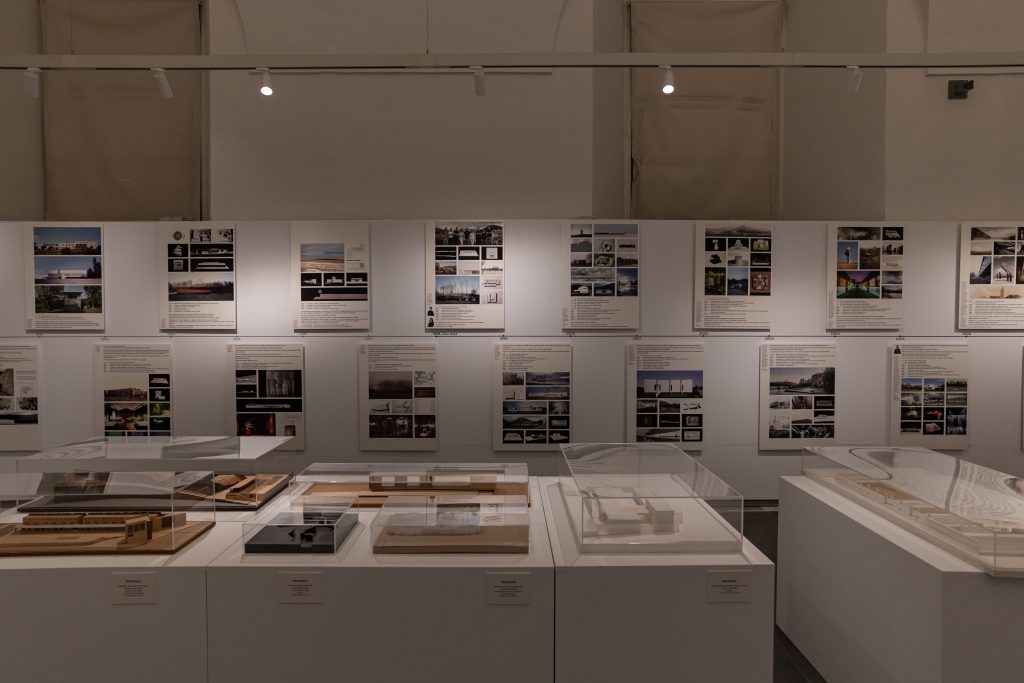
Beginnings
1960·61·62 Ramon is born in Vic, and Rafael and Carme are born in Olot.
1963 Rafael starts school at the María Reina School in Olot.
1966 Ramon starts school at the Malagrida Public School in Olot, and Rafael at the Escola Pia in Olot.
1968 Carme starts school at the Carmelites School in Les Preses at age 6.
1972 Carme attends the Malagrida Public School in Olot.
1973-76 Ramon takes courses at the School of Fine Arts in Olot.
1975-76 We begin at Montsacopa High School in Olot. First Ramon and Rafael; later Carme.
1977-79 Carme studies at the School of Fine Arts in Olot.
In 1978, Ramon, together with Manel and his father, designs and builds the Jesús Vilalta studio, which passes away the following year at the age of 50.
1979-80 Ramon and Rafael study architecture at the Vallès School of Architecture (ETSAV); a year later, Carme. Six years of studies, including training and a final degree project (PFC).
1983-85 Very early on, we carry out the design and construction of the renovation of the Can Cardenal farmhouse, in Batet de la Serra.
1985 Trip to Greece at the end of the sixth year, with professors from ETSAV and ETSAB.
We discover and experience the value of the relationship between architecture and significant places in the landscape.
1986-87 Design and construction of a commercial warehouse in an industrial setting. It will be selected in the first FAD Awards at the Catalan level. It is the first recognition of a work and a source of great excitement and joy. Promoted by Lagares & Vila, Olot.
1987 On January 26, Rafael and Ramon pass their final degree project (PFC), and Carme on November 17.
We decide to share creativity in Olot: Aranda/Pigem/Vilalta is born.
The first work will be assisting the public during the public information period of the Special Plan for the Volcanic Zone of La Garrotxa.
The first studio will be Jesús Vilalta’s.
1988
Days without distinctions become very long and intense; enthusiasm, passion, and love for what we do guide us.
We win our first competition: the National Lighthouse Competition at Punta Aldea, on the island of Gran Canaria.
The experience is remarkable; it shows how much we value this idea.
The project introduces a typological shift; it is disruptive (30-6-1988).
We think and practice making a “tabula rasa,” starting from emptiness, from the origin, so as not to be conditioned and to generate the unknown.
Ramón undertakes the master’s in landscape architecture at ETSAB (1988–1990).
Carme is the ETSAV representative at the International Laboratory of Architecture and Urban Design (ILAUD) in Siena, Italy.
Ramon wins the IV N. M. Rubió i Tudurí Prize for Architecture and Gardening, PFC.
1988 Lighthouse at Punta Aldea, Gran Canaria. First prize in the competition. RCR arquitectes / M. Tàpies.
1988-91 Gaudí Housing, in Olot, Girona.
1988-91 Margarida House, in Olot, Girona.
1988-92 Hotel**** Albons Calm, in Albons, Girona. First prize in a restricted competition.
Once the project is found, it is about developing it with love, passion, and depth. The task does not matter; what matters is the attitude with which it is carried out.
If the purpose is born from the heart, it is right. Then there is something that guides us along our own path.
Illustration from the white book of the monographic exhibition WORKS 1988–98 ARANDA PIGEM VILALTA ARCHITECTS, at the Ozone Living Design Centre Gallery in Tokyo, 1997, where thanks are given to the people who were part of their first ten years of work.
この本を上梓するに当たり、さまざまな形でご協力いただいたたくさんの方々に心から感謝しています。特に次の方々にはこの場を借りてお礼を述べたいと思います。Y. Koizumi, M. Fujino, Sh. Hagiwara, M. Checinski, Mf. Micchael-Kova, M. Nakatani, Y. Shakuta, また、ここに掲載した作品の設計、建築を私たちに任せてくださった次の方々にも心から感謝を捧げます。H. Machida, P. Macias, F. Ventura, M. Ginesta – Mr. Bagué, J. Benedito-M.de Pablo, S. Delàs, J. Vicens, J. Falgarona, E. Planadecursach, I. Brussosa, L. Donado, J. Hugas, R. Fortet, I. Pigem- J. Barceló, M. Lagares – M. Vilalta, V. Tàpies, F. Asensio – C. Acero, J. Marguí – G. Anglada, X. Ruscalleda – P. Farjas
1989
The dissemination of the Lighthouse project leads to an invitation from the Japanese company IC Works to participate in a restricted competition for a restaurant and commercial area on Saikaibashi Island, Japan. We win the first prize.
We also take part in the competition for the Catalonia Pavilion at Expo 92 in Seville. X. Ruiz and P. Llimona win the competition.
We set up our studio at Passeig d’en Blay 34, in Olot, with the help of our families.
Ramón is awarded a grant for the Training of Teaching and Research Staff from the Ministry of Education and Science (MEC), 1989–92 and is a professor of Urban Planning and Landscape Architecture at the Vallès School of Architecture (ETSAV), 1989–2001.
1989 Portal of the Can Cardenal cabin, in the Volcanic Zone of La Garrotxa, Girona.
1989 Saikaibashi, in Nagasaki, Japan. First prize in a restricted competition.
1989-90 Olympic Village Housing “Barcelona 92”, in Banyoles, Girona. RCR arquitectes / R. Fortet.
1989-90 “The Fluvial Space and Leisure. Olot 2002”, in Olot, Girona.
1989-91 El Clavell, in the Volcanic Zone of La Garrotxa, Girona.
1990 El Croquis Editorial selects us among the ten Spanish architects under 40 for the III International Architecture Salon at La Villette, in France, for the Punta Aldea Lighthouse and significant work, on July 2, 1990.
Work and study trip to Japan, invited by IC Works. This trip will have a great impact on our perception, sensitivity, and cohesion. It will be magical!
The flight over Alaska is an exceptional experience and remains etched in our hearts.
On the return flight, we decide to share a single table.
The ideals we value most are love, freedom, and creativity.
1990 Reception and access area to the Fageda d’en Jordà, in the Volcanic Zone of La Garrotxa, Girona.
1990 Catalonia Pavilion at Expo ’92, in Seville. Restricted competition. Collaborators: M. Tàpies, A. Sáez.
1990 “Els Salts” micro hydroelectric power plant, in Castellserà, Lleida.
1991
We often remind ourselves that, throughout the entire design process, the trees must still allow us to see the forest.
We learn that uncertainty is the path to freedom, and that security lies in understanding it. Without uncertainty, life is repetition!
1988-91 Gaudí Housing, in Olot, Girona.
1989-91 El Clavell, in the Volcanic Zone of La Garrotxa, Girona.
1991-92 Special Plan for the Aigüestortes–Estany de Sant Maurici National Park, in Lleida. First prize in the competition.
1991-92 Master Plan for the use and management of the Aigüestortes–Estany de Sant Maurici National Park, in Lleida. First prize in the competition.
1991-92 Guest Pavilion at Can Cardenal, in the Volcanic Zone of La Garrotxa, Girona.
1991-93 Torrent dels Llops III-IV, in Martorell, Barcelona.
1991-97 Pau Casals Housing, in Palau d’Anglesola, Lleida.
1991-00 Tossols Basil Athletics Stadium, in Olot, Girona.
1992
Antonio Sáez replaces Ramon at the School of Art in Olot.
We learn to share with the conviction that the result is greater than the sum of its parts.
We seek excellence throughout the entire architectural process. We try to imbue the created atmospheres with spirit.
Carme is a Design professor at the Vallès School of Architecture (ETSAV), 1992–99.
1988-92 Margarida House, in Olot, Girona.
1988-92 Hotel**** Albons Calm, in Albons, Girona. Albons Calm Hotel catalogue book.
1991-92 Guest Pavilion at Can Cardenal, in the Volcanic Zone of La Garrotxa, Girona.
1993
We believe in shared creativity!
An open-ended conversation, from which new ideas can emerge, is magic.
Casa Margarida was first published in the magazine El Croquis, in an issue dedicated to Spanish architecture.
In the text “Minimalisms,” J. M. Montaner says of RCR: “…especially skilled at situating themselves in a place, Casa Margarida stands out as a clean and minimalist work.” It is the first written comment by an architecture critic.
Oriol Bohigas visits Casa Margarida: “…a very clear house, full of interesting relationships… having volume of space is quality…”
First book: The Fluvià River as a pretext. Study and intervention in the landscape.
1991-93 Torrent dels Llops III-IV, in Martorell, Barcelona.
1993 Exhibition and catalogue “Frameworks. 10 years of the General Plan”, in Olot, Girona.
1993 Exhibition “The Imaginary City”. Work for The Artist of the Month in Olot, Girona.
1993 Proposal for conceptualisation and regulations on “Ecological campgrounds.”
1993 Special plan for the protection and improvement of the historic centre of Sant Feliu de Pallerols, Girona. Catalogue “Sequencies”.
1993 Research project “Hydraulic Works in the Pyrenees”, grant from the La Caixa Foundation.
1993-94 Access Pavilion to the Fageda d’en Jordà, in the Volcanic Zone of La Garrotxa, Girona.
1994
We travel across the United States; we want to set foot on the places shown in the images from the flight over Alaska on our trip to Japan.
Washington, D.C., Seattle, Anchorage, Newark, Chicago, New York, the MIT in Chicago, and several works by Frank Lloyd Wright…
We learn to share our own experiences as if we had all lived them, intensely sharing perceptions, which gives us great cohesion.
Film “Le Volcan, la Forêt et les Architectes”, FR3 MF. Michal-Kova, M. Checinski.
Margarida House is a finalist in the Spanish Architecture Exhibition, 1991–93.
El Croquis, Spanish Architecture 1994, featuring the access pavilion to the Fageda d’en Jordà.
1993-94 Access Pavilion to the Fageda d’en Jordà, in the Volcanic Zone of La Garrotxa, Girona.
1994 Ecopolis. Low environmental impact housing.
1994 Studio for a Painter, in Olot, Girona.
1994 T House, in Olot, Girona.
1994-99 Mirador House, in Olot, Girona.
1994-99 Spaces for Leisure and Culture, in Riudaura, Girona.
1995
It does not matter from whom the word, the hand, or the energy comes; what matters is the idea: to go far.
We do not separate “work” from the rest of life because we do not feel that we are working.
Carme is a member of the final-degree-project jury at the Vallès School of Architecture (ETSAV), 1995–03.
Euro-Belgian Architectural Awards Prize for Margarida House, in Brussels.
We discover the work of Juliaan Lampens in a monographic exhibition and meet Klaas and Rose Goris, as well as Ralf and Isabel Coussée.
Anna Aranda i Mayans is born on March 12, 1995.
1995 Can Passavent, on the Croscat volcano in the Natural Park of the Volcanic Zone of La Garrotxa, Girona.
1995-98 Tossols Basil Bathing Pavilion, in Olot, Girona.
1995-99 Faculty of Law at the University of Girona, Girona.
1995-99 Vilartagues Secondary School, in Sant Feliu de Guíxols, Girona.
1996
A basic model of the global operational structure (TOP) is gradually consolidated.
A dynamic model, with fundamental pillars to help develop creativity.
Trip to the United States: we make a large triangular journey by car across the American prairie, covering more than 4,000 km.
Los Angeles, Santa Monica, Aspen, Boulder, Des Moines, the bridges of Madison County, Iowa City, Chicago, Dallas, Fort Worth, Houston, La Jolla, Amarillo, San Juan de Capistrano, New York and its surroundings.
We visit works by the masters—we see them, touch them, feel them…
Travel nourishes our experiences and emotions.
Knowledge can be taught in schools and universities; we value experience as something mysterious that is transmitted to us; we understand it, and understanding opens our awareness.
1996-00 House for an editor, in Esplugues de Llobregat, Barcelona.
1996-00 Sphere of Light, in the Haven of Palamós, Girona. First prize in a restricted competition.
1996-00 Roser House, in Sant Privat d’en Bas, Girona.
1996-00 House for a Blacksmith and a Hairdresser, in La Canya, Girona.
1997
What matters, what prevails, is the idea—not the forms or the scale of the work.
We are travelling to Japan again for the monographic exhibition at the Ozone Gallery in Tokyo. The white catalogue is published.
We conduct a monographic visit to more than a dozen of Tadao Ando’s works to experience them and better understand his writings.
Carme is a professor at the Barcelona School of Architecture (ETSAB), in the chair of J. Ll. Mateo, 1997–2003.
We receive the Fine Arts and Design Grant in Olot.
With accumulated experience and a constant desire for improvement, manuals are developed to facilitate task execution.
1991-97 Pau Casals Housing, in Palau d’Anglesola, Lleida.
1997-98 Equus Parc de Catalunya, in the equestrian and leisure area, in Bàscara, Girona.
1997-01 Bellow House, in Les Preses, Girona.
1997-04 Pedra Tosca Park, in Les Preses, Girona.
1998
Gemma Puigvert joins us on February 10, 1998.
And Marta Subirós, on April 14, 1998.
The structure, values, principles, and ways of working are consolidated (1988–98).
1995-98 Tossols Basil Bathing Pavilion, in Olot, Girona.
1998 Can Jordà, in Santa Pau, Girona.
1998 COOC Casino Olotí Olot Cosmopolita, in Olot, Girona.
1998 H House – two houses for two brothers, in Begur, Girona.
1998-99 House for a Painter, in Sales de Llierca, Girona.
1998-00 Nativity Scene Headquarters, in Bàscara, Girona.
1998-00 Vilartagues Sports Complex, in Sant Feliu de Guíxols, Girona.
1998-05 Grove Park, in Begur, Girona.
1998-15 A House – two houses for two brothers, in Begur, Girona.
1999
We soon learn that the value of ideas lies not only in having them, but also in the ability to carry them out and build them.
Exhibition at the Sala Oberta of the Museum of La Garrotxa. The black catalogue is published.
Carme is offered a position as a professor at ETH Zurich, but declines.
1999 Tossols Basil Park Pathway, in Olot, Girona.
1994-99 Mirador House, in Olot, Girona.
1994-99 Spaces for leisure and culture, in Riudaura, Girona.
1995-99 Faculty of Law, University of Girona, Girona.
1995-99 Vilartagues Secondary School, in Sant Feliu de Guíxols, Girona.
1999 New Courthouses, in Tarragona. First prize in the competition.
1999 Hotel**** Ultònia, in Girona.
1999-00 Vernio, in Olot, Girona.
1999-00 Tossols Basil 2×1 Pavilion, in Olot, Girona.
1999-05 Firefly House, in Olot, Girona.
1999-15 House Between Two Walls, in Jaca, Huesca.
2000
40 Architects under 40, Jessica Cargill Thompson. Taschen. A highly influential book on a new international generation that is strongly consolidating.
Victoria Vilalta Pigem is born on June 16, 2000..
1991-00 Tossols Basil Athletics Stadium, in Olot, Girona.
1996-00 House for a Blacksmith and a Hairdresser, in La Canya, Girona.
1996-00 House for an Editor, in Esplugues de Llobregat, Barcelona.
1996-00 Roser House, in Sant Privat d’en Bas, Girona.
1996-00 Sphere of Light, in the haven of Palamós, Girona.
1999-00 Vernio, in Olot, Girona.
1999-00 Tossols Basil 2×1 Pavilion, in Olot, Girona.
2000 Service building at the Montilivi Campus of the University of Girona, Girona. Restricted competition.
2000 Housing complex in Salt, Girona. Restricted competition.
2000 Sailing and Underwater Activities Centre, at the marina, Barcelona.
2000 Seafront Promenade, in Vila Joiosa, Alacant.
2000-02 M-Lídia House, in Montagut, Girona.
2000-02 Meteorological Radar, in Puig d’Arqués de les Gabarres, Girona.
2000-07 Horizon House, in La Vall de Bianya, Girona.
2001
We believe that creativity is the imperceptible, secret force of animation that generates everything in the universe.
Exhibition at the Museo Nacional Centro de Arte Reina Sofía in Madrid: “Minimalisms, a sign of times”, featuring the Tossols Basil Bathing Pavilion, Olot, on July 11, 2001.
Carme is a member of the final degree project jury at the Barcelona School of Architecture (ETSAB).
1997-01 Bellow House, in Les Preses, Girona.
2001 Nova Mar Bella Park, in Barcelona. 1st prize in the competition.
2001 Volcanic Gate, in the river corridor between Montagut and Castellfollit de la Roca, Girona.
2001-02 Les Cols Restaurant, in Olot, Girona.
2001-04 Pond and garden for Mirador House, in Olot, Girona.
2001-04 Electronics Workshop, in Sant Joan les Fonts, Girona.
2001-04 “Els Colors” Kindergarten, in Manlleu, Barcelona.
2001-06 Indoor Swimming Pool, in Manlleu, Barcelona.
2001-17 Pavilion at the Pond, in Llagostera, Girona.
2002
Gilles Trégouët begins working at the studio on June 3, 2002; he will take a break on July 18, 2003, to finish his studies and will return on March 21, 2005.
Carme is a member of the final project jury at the Barcelona School of Architecture (ETSAB), 2002–03.
Landscape Architecture:
Architecture is the art that materialises content within a container.
The landscape is the natural or urban environment that accompanies all architecture.
2000-02 M-Lídia House, in Montagut, Girona.
2001-02 Les Cols Restaurant, in Olot, Girona.
2002 Rest Pavilion, in the Volcanic Zone of La Garrotxa, Girona.
2002 “Charme” Hotel, in Boulogne-Billancourt, France. Second prize in a restricted competition.
2002-03 Pond at “La Vila” de Trincheria, in La Vall de Bianya, Girona.
2002-04 Weather Radar at Creu del Vent, in Montmaneu, Barcelona.
2002-05 Les Cols Pavilions, in Olot, Girona.
2002-07 House for a Carpenter, in Olot, Girona.
2002-07 San Antonio–Joan Oliver Library, senior citizens’ centre, and Cándida Pérez gardens, in the Sant Antoni neighbourhood, Barcelona. First prize in a restricted competition.
2002-08 Weather Radar at the Llaberia viewpoint, in Tivissa, Tarragona.
2003
The truths we assume are not dogmas, and for that reason, we constantly challenge ourselves to grow.
The publishing house El Croquis: monographic dossier 1999–2003 Crystallisations, with text by Carles Martí. A firm step in what we can call the third generation of projects.
Carme is a professor of Landscape Architecture at the Barcelona School of Architecture (ETSAB), 2003–05.
2002-03 Pond at “La Vila” de Trincheria, in La Vall de Bianya, Girona.
2003 7th Spanish Architecture Biennial, in Comillas, Madrid, Seville, Granada, Vigo, León, Salamanca, and Barcelona.
2003 Volcanic Urban Space, in Olot, Girona. 1st prize in the competition.
2003-07 Bell-Lloc Winery, in Palamós, Girona. 1st prize in a restricted competition.
2003-10 Meeting Point at Mas “El Vent,” in La Fosca de Palamós, Girona. 1st prize in a restricted competition.
2003-10 Pavilion at Mas “El Vent,” in La Fosca of Palamós, Girona.
2003-11 Public Space La Lira Theatre, in Ripoll, Girona. 1st prize in the competition. RCR arquitectes / J. Puigcorbé.
2003-21 Perelada Winery, in Peralada, Girona.
2004
We feel that evolving means not standing still; it is simply moving forward to adapt to the environment. To change to grow is to surpass the environment.
Selection of works from the book The Phaidon Atlas of Contemporary World Architecture.
RCR Aranda, Pigem, Vilalta Arquitectes: Between Abstraction and Nature, by William J. R. Curtis. Publication of a monographic book covering the complete body of work to date. GG.
After years of longing for the Barberí Space, we finally made it a reality on April 30, 2004.
1997-04 Pedra Tosca Park, in Les Preses, Girona.
2001-04 “Els Colors” Kindergarten, in Manlleu, Barcelona.
2001-04 Pond and garden for Mirador House, in Olot, Girona.
2001-04 Weather Radar at Creu del Vent, in Montmaneu, Barcelona.
2002-04 Jacinto Verdaguer Cultural Centre, in Folgueroles, Barcelona.
2004 New complex of Sants Station, in Barcelona. First prize in the competition. RCR arquitectes / MAP.
2004 Thermal Centre and Spa Hotel, in Caldas de Reis, Pontevedra. First prize in the competition.
2004-08 Bikini Hall, in the Les Corts neighbourhood, Barcelona.
2004-15 Indoor Swimming Pool, in Taradell, Barcelona.
2005
National Culture Award of the Generalitat de Catalunya for the “Els Colors” Kindergarten in Manlleu. It is the first edition in which Architecture is awarded.
Gilles Trégouët, from Vannes, joins the studio on March 21, 2005.
The book Contemporary Architecture in Catalonia, by J. M. Montaner, concludes with RCR Arquitectes (10-2005).
Selection and exhibition at the MoMA in New York, “ON-SITE: New Architecture in Spain,” featuring the “Rural House” in La Vall de Bianya and the “Els Colors” Kindergarten in Manlleu.
The New York Times: “Top, Rural House by RCR Arquitectes,” photograph and text, December 11, 2005.
1998-05 Grove Park, in Begur, Girona.
1999-05 Firefly House, in Olot, Girona.
2002-05 Les Cols Pavilions, in Olot, Girona.
2005 House for an Architect, in Ghent, Belgium.
2005 PGA Golf de Catalunya Housing, in Caldes de Malavella, Girona.
2005 Esteve Laboratories, in Sant Cugat, Barcelona. First prize in a restricted competition.
2005 Paravent House, in Pals, Girona.
2005 Creativity Centre and Club Residence at the new ESADE campus, in Sant Cugat, Barcelona.
2005-07 Lotus Blau Shade Spaces, in Santa Coloma de Farners, Girona.
2005-10 “El Petit Comte” Kindergarten, in Besalú, Girona. First prize in the competition. RCR arquitectes / A. Clemente.
2005-12 Barberí Space, in Olot, Girona.
2006
Isabel Vilalta Pigem is born on January 5, 2006.
Noèlia Baldayo begins working at the studio on November 20, 2006, and remains until March 31, 2009; she will return on July 1, 2013.
We understand art and architecture as creative activities in the pursuit of beauty. Beauty, in essence, escapes any commentary; it can only be felt.
We live life as a constant search for balance, a continuous process. For us, balance is not a static phenomenon in life, but a dynamic one.
2006 Hammershøi in the Light of Dreyer, at the CCCB, Barcelona.
2001-06 Indoor Swimming Pool, in Manlleu, Barcelona.
2006 Meditel Headquarters in Casablanca, Morocco. First prize in the competition. RCR arquitectes / J. Puigcorbé.
2006 House for a Photographer, in Sant Esteve de Llémena, Girona.
2006 Access Pavilion to the Ullastret Archaeological Site, in Ullastret, Girona. First prize in a restricted competition.
2006 Nova Mar Bella Park: Elements, in Barcelona. First prize in the competition.
2006 Stables for People and Horses, Mas Salvà, in Palamós, Girona.
2006-11 Office Building Plaza Europa 31, in L’Hospitalet de Llobregat, Barcelona.
2006-13 Hofheide Crematorium, Belgium. First prize in the competition. RCR arquitectes / Coussée & Goris architecten.
2007
Only human beings can project the future, to imagine and to dream…
Fighting for a dream also gives life meaning.
And the best moments are those in which we make our dreams come true.
We move to the Barberí Space to better conceive a project like The Edge, which spans more than 600,000 m².
Ângela Moura, from Seixal, and Verónica Vitoriano, from Avanca, join the studio on September 13, 2007.
2000-07 Horizon House, in La Vall de Bianya, Girona.
2002-07 House for a Carpenter, in Olot, Girona.
2002-07 Sant Antoni – Joan Oliver Library, senior citizens’ centre, and Cándida Pérez gardens, in the Sant Antoni neighbourhood, Barcelona.
2003-07 Bell-Lloc Winery, in Palamós, Girona.
2005-07 Lotus Blau Shade Structures, in Santa Coloma de Farners, Girona.
2007 Cultural Centre, in Zwevegem, Belgium. First prize in the competition. RCR arquitectes / Coussée & Goris architecten.
2007 Habitacles, in la Fosca de Palamós, Girona.
2007 The Edge, in Dubai Business Bay, Dubai. First prize in the competition. RCR arquitectes / Coussée & Goris architecten.
2007 Rest Area of the Roman Road, Girona.
2007-11 Restaurant Les Cols Marquee, in Olot, Girona.
2008
Twenty years of RCR sharing intensely, with perception, intuition, and intensity.
Ascent of Canigó mountain, with meaning.
We feel satisfied: we have reached the summit of our aspirations in architecture; we have even surpassed them.
Lectures, classes, projects, writings… cities follow one another over the years, some even repeated several times: Barcelona, Terrassa, Vic, Manresa, Lleida, Tortosa, Tarragona, Valencia, Madrid, Valladolid, Zaragoza, Bilbao, Pamplona, Badajoz, Vigo, Santiago de Compostela, A Coruña, Granada, Seville, Almería, Murcia, Santander, Córdoba, Cádiz, Castellón, Palma, Menorca, Gran Canaria, Tenerife, Porto, Lisbon, Toulouse, Paris, Rennes, Zagreb, Stuttgart, Leuven, Bielefeld, Nicosia, Rheda-Wiedenbrück, Frankfurt, Hanover, Kotka, Biel/Bienne, Oslo, Milan, Carrara, Wales, Dublin, Cork, Copenhagen, Bruges, Tokyo, Guadalajara, Mexico City.
Study trip to Egypt to face the challenge of The Edge project, in Dubai.
We are appointed Chevaliers de l’Ordre des Arts et des Lettres, France.
We believe that good architecture, like almost everything in life, should tend toward silence rather than an excess of words, and aspire to simplicity.
2002-08 Weather Radar, at the Llaberia viewpoint, Tivissa, Tarragona.
2004-08 Bikini Hall, in the Les Corts neighbourhood, Barcelona.
2008 Hotel Bab al Jinan, in Bawadi, Dubai.
2008-09 Lagares Showroom, in Fornells de la Selva, Girona.
2008-14 Soulages Museum, in Rodez, France. First prize in the international competition. RCR arquitectes / G. Trégouët. Collaborators: Passelac & Roques Architectes.
Final
“(…) in barely two decades they have built in the region a body of work with a singular language that brings together the romantic impulse of communion with nature and the search for the sublime in extreme reduction, with a rational commitment to geometric rigour, abstract composition, and constructive refinement in the detailing of materials with intense tactility.”
Fernández Galiano, Luis. RCR, Romanticism with Rigour, 2009.
18-12-2009 Josefina, Carme’s mother, passes away, a painful time of intense emotions.
2010 In Miami, Florida, they are awarded the Honorary Fellowship of the American Institute of Architects, AIA.
11-01-2010 Idurre García, from Arrasate-Mondragón, joins the studio.
12-06-2011 Death of Montse Mayans at the age of 50. A sad and confusing period. We begin a clouded decade.
01-07-2013 Noèlia Baldayo, from Sagunt, joins the studio.
2014 Gold Medal of the French Academy of Architecture; we are told it is the prelude to the Pritzker.
07-01-2016 Andrea Buchner, from Chile, joins the studio.
17-01-2017 Notification that we have been awarded the Pritzker Prize.
Carme becomes the first Pritzker mother, and together with Ramon, they are the first couple. It is also the first time it has been awarded to three people simultaneously. The Pritzker Prize is a personal (individual) recognition.
17-07-2017 Captivated by its beauty, we acquire La Vila as a new dream.
Permanent Exhibition of the Museum - RCR in Dialogue with Culture
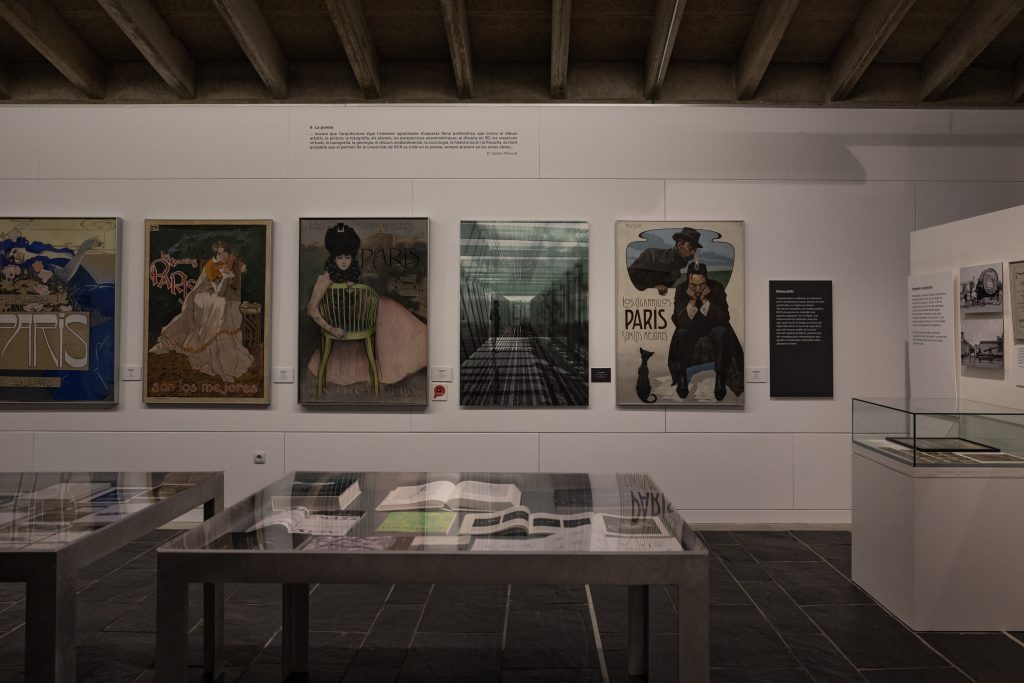
RCR in Dialogue with Culture: the journey continues with an interaction with the Museum’s permanent exhibition, on the third floor, which contextualises the cultural and artistic evolution of Olot—from the School of Art and local industry to the protest art movement of the 1970s—showing how RCR integrates into this cultural fabric. Visitors will see furniture, industrial design, selections of the studio’s drawings, paintings, sculptures, photographs of their work, and Barberí Space, which houses their studio, as an example of dialogue with Olot’s industrial and artistic memory
0 · Introductory Text
RCR arquitectes, in dialogue with the Museum of La Garrotxa
Roots need a place to be planted, and wings require a foundation from which to soar. The culture of La Garrotxa has always been interconnected with other cultures, from Paris—where local figures like M. Malagrida found inspiration—to American and Asian regions where local art and craftsmanship were exported. As a result, the culture of La Garrotxa is cosmopolitan, allowing artists like Rafael, Carme, and Ramon to thrive.
The Museum’s permanent exhibition traces the studio’s production, showcasing buildings, graphic work, design, and photography. This is complemented by quotes from “The Poetics of Architecture” by D. Giralt-Miracle, providing a fresh perspective.
The culture of La Garrotxa is an ongoing creation, and this exhibition vibrantly captures one of its most recent chapters.
1 · The Garrotxa Museum Hall
La Garrotxa: Roots and Context
Understanding the work of RCR Arquitectes is challenging—almost impossible—without considering their roots and the context in which they operate. The geological and environmental framework of La Garrotxa has undoubtedly been a crucial element in shaping its creations and continues to influence it today.
D. Giralt-Miracle
2 · Late 18th Century
- Chaise longue Territory Cercas
- Iola wooden benches
Furniture
The furniture designed by RCR Arquitectes is seamlessly integrated into the architecture, enhancing the space’s identity. This is exemplified by the Olot beds, which are designed to softly accentuate the dim light of an alcove.
Cercas Territory (2017), created for the writer Javier Cercas, along with the wooden versions of the Iola benches (1991)—which replicate the original concrete pieces—demonstrate this approach. Additionally, the evolution of the design for the Malecaze House in Toulouse (2009–2016) showcases the meticulous attention to detail present in every component of their work.
Cercas Universe
In 2017, the American Hardwood Export Council invited RCR Arquitectes to design a unique piece of furniture. The architects proposed a chaise longue that would provide writer Javier Cercas with a comfortable space for reading and writing. This piece, crafted entirely from cherry wood, is based on a body scan of Cercas, allowing for a custom fit that perfectly adapts to his physique. It is designed to envelop him like a glove and features movable parts that facilitate a variety of activities.
Thus, Cercas Territory was created—a piece that explores the customisation possibilities offered by modern technologies applied to wood.
3a · Early 19th Century and Joaquim Vayreda
- Shepherd Figure
The Strength of the Territory
And indeed, their sensitivity could not remain indifferent to this humid territory of exuberant vegetation… and which possesses an unusual telluric power due to the rugged geography shaped by mountains and volcanoes…
D. Giralt-Miracle
The Territory as a Reference
This unique and intense landscape is integral to RCR’s work. It’s difficult to determine whether this environment inspires their architectural philosophy or if they intentionally adapted their designs to reflect the region. What is clear is that without this setting, RCR’s architecture would not exist…
D. Giralt-Miracle
3b · Early 19th Century and Joaquim Vayreda
- Enigma Sketch E036
- Sketches Japan A011, A012, A013
Joaquim Vayreda and Art
The watercolours and other graphic expressions used by RCR Arquitectes become independent of the projects they are associated with, thus gaining autonomy. Through this medium, standalone works can be created and exhibited independently. In contrast to Summer, there is Enigma, a large-format watercolour that features a central composition similar to Joaquim Vayreda’s painting. Once digitised, this work serves as the basis for a design that, when printed on ceramic, is used for the flooring, walls, and furniture of Enigma Space (2014–16), a Barcelona restaurant by Albert Adrià that has earned two Michelin stars.
The Calligraphic Gesture
The spontaneous brushstrokes, calligraphic gestures, and movement of forms found in the sketches that precede all their projects reveal a distinctive language. This language echoes the characteristics of American abstract expressionism and reflects the sign-based writing of the Catalan painter Antoni Tàpies.
D. Giralt-Miracle
4 · Marian Vayreda
5 · Josep Berga i Boix, Modernism and Miquel Blay
- RCR photographs and the landscape
Josep Berga i Boix and the Landscape
The paintings of the Olot School of Landscape, especially those by brothers Joaquim and Marian Vayreda and Josep Berga i Boix, evoke a strong sense of recognition and connection to the territory. This identification with the land serves as the foundation for all interventions in the area by RCR Arquitectes. The houses constructed in La Garrotxa are designed with this sensitivity, integrating seamlessly into the landscape, much like the farmhouses depicted in Berga i Boix’s artwork, which Hisao Suzuki photographs. This exhibition serves as a prime example of this relationship.
The Principles of Rural Houses
…RCR has revisited and further developed the methodology established in the 1930s by the rationalist architects of GATCPAC, who were followers of Le Corbusier. Their efforts focused on the rural architecture of Ibiza, where they not only catalogued the existing farmhouses on the island but also documented all their variations. This approach aimed to create a dialogue between these farmhouses and their own architectural principles.
D. Giralt-Miracle
- Cloud Woman and Man
RCR arquitectes: an Olot-Based Identity
RCR arquitectes is located in Olot, where its founders, Rafael Aranda, Carme Pigem, and Ramon Vilalta, were educated, reside, and practice their craft. Since its establishment, the studio has been actively engaged in the city’s life by designing and constructing public spaces. Each project is infused with a relational dimension, allowing it to be viewed as an integral part of the urban environment. Additionally, they have served as consulting architects for the Natural Park of the Volcanic Zone of La Garrotxa since 1987.
Since 2012, RCR arquitectes has held a Summer Workshop that reflects on the city of Olot, elevating its profile on the international architectural stage and establishing it as one of the most significant locations in Europe within the global architectural context. Currently, they are working on RCR La Vila, a centre dedicated to creativity and research in the Vall de Bianya.
In 2017, the architects were honoured with the Pritzker Architecture Prize and the Gold Medal of the Generalitat de Catalunya, as well as the Medal of the City of Olot, further highlighting their contributions to architecture and the community.
6 · Miquel Blay
7a · “Cigarrillos París”, The Charge and Josep Berga i Boada
- Tables: RCR and Graphic Design
- Digital visualizations of various projects
- Visualizations of Les Cols Pavilions
Graphic Design
Architecture is initially drawn and communicated through visualisations before it is constructed, and it is also recorded in books. Every studio requires a graphic identity. RCR arquitectes has engaged in all these areas and has also undertaken a significant amount of editorial work. This room, which features the Cigarrillos París brand image, adds another layer to the studio’s graphic design efforts, encompassing everything from the logo to books, as well as computer visualisations that help convey the project’s atmosphere to the client.
Poetry
… Architecture serves as the central theme of this diverse body of work, which encompasses artistic drawing, painting, photography, plans, axonometric perspectives, 3D design, virtual creations, topography, geology, environmental discourse, sociology, local history, and philosophy. However, the foundation of RCR’s creativity is likely rooted in poetry, which consistently resonates throughout their creations…
D. Giralt-Miracle
7b · “Cigarrillos Paris”, The Charge and Josep Berga i Boada
- Iola glass benches
7c · “Cigarrillos Paris”, The Charge and Josep Berga i Boada
- Photographs of the exhibition Hammershǿi and Dreyer
- Photographs Destellos
- Photography The Dream of La Vila
Ephemeral
All architecture is connected to its time. Ephemeral architecture, which relates to the creation of an exhibition’s atmosphere or a temporary pavilion, captures the essence of that era. It helps construct the memory of a moment in history. RCR Arquitectes has developed several ephemeral architecture projects that reflect different stages in the studio’s journey.
“Destellos”, a travelling exhibition created for the 7th Spanish Architecture Biennial in 2003, marked a significant turning point. The exhibition “Hammershøi and Dreyer,” conducted in 2007 at the CCCB, establishes a dialogue between the Danish painter and filmmaker during the peak period of the studio’s development. Lastly, “RCR Vila’s Dream,” presented ten years later at the Catalonia Pavilion of the Venice Biennale, celebrates the studio’s receipt of the Pritzker Prize and the beginning of a new project focused on creativity and research.
8 · The Noucentisme
- Toi-et-moi, Colette and Pierre Soulages
9 · Josep Clarà and Francesc Vayreda
- Photographs of sculptures by Josep Clarà at Can Barberí
- Old photograph of the Can Barberí Foundry
Josep Clarà and the Barberí Foundry
The bronze sculptures of Josep Clarà were cast in Olot, with the Barberí artistic foundry handling the process in collaboration with the artist himself.
In 2004, RCR arquitectes acquired the complex, previously occupied by the foundry, located between Joan Pere Fontanella and Marià Vayreda streets. This new space allowed the studio to expand, providing larger surfaces, multifunctional areas, and a Pavilion of Dreams for presentations, exhibitions, and creative activities.
Today, the international spirit of the space continues, as architectural projects from three continents are developed there. The foundry still preserves various objects, and plaster and cast works by Josep Clarà are on display.
The relationship with the foundry has infused the walls with experiences and energy that are clearly felt today.
Summary of the Sculpture-making Process in relation to the Barberí Foundry (extracted from Josep Clarà’s diary by RCR arquitectes)
13 August 1912. In Sabadell, I am commissioned to execute the monument to the economist Sallarès.
9 February 1916. Today I finished my statue for the Sallarès monument in Sabadell.
12 June. Letter from the Olot founder. He says the statue’s mould is ready, and they will begin the wax work.
29 June. From 7 in the morning until evening, I go to the foundry to retouch the wax of the Sabadell monument statue.
30 June. All day retouching the wax. It is not very successful, which causes me immense work correcting others’ mistakes.
1 and 2 July. Days spent retouching the wax—long and laborious work.
4 July. I finish the lower parts of the statue. Work begins on preparing the mould for casting.
25 July. As I am about to leave for Olot to collect the statue, I receive a letter from the founder. Everything has failed. The statue caused the ground on which it rested to give way slightly… The operation must be repeated. The founder is almost beside himself. All the retouching work again. I prepare for a second journey and a new phase of work.
9 December. I received word from the Olot founder that the casting of the statue, which I had redone and whose wax I must retouch again, has succeeded.
16 December. The statue is completely finished.
17 December. All of Olot visits the Barberí foundry workshops, where the Sabadell statue is exhibited.
18 December. The founder and I discuss the price. I offer him 500 pesetas more than he asks, and he is very pleased. In this matter, I am the one who has lost the most.
21 January 1917. Inauguration.
The Essence of La Garrotxa in the World
Miró, Dalí, Gaudí—three influential figures from the 19th and 20th centuries—are now joined by RCR, who, through their work in the 21st century, bring the essence of La Garrotxa to a global audience.
D. Giralt-Miracle
Nature at the Origin
For Gaudí, all architectural styles were, in one way or another, inspired by nature—specifically his Mediterranean surroundings. This is reflected in his motto: “To be original is to return to the origins.” This principle seems perfectly applicable to Rafael, Carme, and Ramon, as their architecture suggests.
D. Giralt-Miracle
Affinities with Innovative 20th-Century Art
… The most distinguishing feature of RCR’s work is the conceptual and aesthetic connections it shares with the most innovative art of the 20th century. This is evident in the materials, textures, and colour palettes they employ. For example, they use Corten steel surfaces reminiscent of the works of artists such as Richard Serra, Eduardo Chillida, and Pablo Palazuelo. Additionally, their work reflects the chromatic simplicity found in the pieces of Mark Rothko, Sean Scully, and Pierre Soulages. Furthermore, their designs incorporate elements of significant artistic movements, including land art, op art, kinetic art, constructivism, installation art, and minimalism.
D. Giralt-Miracle
10 · The Artist’s Workshop
- Video Meridionales, le volcan, la fôret et les architectes
11a · The Second Republic and the Post-War Period
- Old photo of the Lagares Carpentry Workshop
- Photos of the Lagares Showroom
- Photos of the Les Cols Pavilions
- Construction drawings WC In
- Marketing WC In
- Lagares: designs of washbasins, sprayers, shower trays, taps, urinals and WC In
Lagares, Three Generations of Carpenters
From the wooden benches of Manel’s grandfather to Manel’s Corian benches, the legacy of craftsmanship continues. Manel’s grandfather opened the workshop in 1918, and his father continued in the same spirit. Manel then brought a high level of technical expertise, allowing him to produce highly complex furniture. Recognising the potential of solid surfaces, Manel, along with RCR, began designing sanitary equipment in 1987. They developed several groundbreaking designs that transformed bathrooms worldwide, establishing Lagares as Spain’s leading company in Corian processing until its closure in 2025.
This small exhibition also serves as a heartfelt acknowledgement of all the industrial collaborators in Olot, especially close partners such as SEI, Construccions Metàl·liques Olot, Talleres Brillauto, Taller Plujà, Fusteria Planella, Marbres i Pedra Artificial Coll, Plantalech, Excavacions Coll, Bellapart, Cros Encofrats, Construccions J. Pallàs, Fustería Jordi, Alumilux, and Soy & Soy Painting and Lacquering…
Beauty in Meaning
… The work of these architects from Olot is deeply intertwined with the concept of beauty. As philosopher Suzuki Daisetsu (1870–1966) stated, “Beauty lies not in form, but in its meaning.” RCR aims to discover and enhance the beauty of their buildings through their design and layout, as well as the materials they select for construction.
D. Giralt-Miracle
Avoiding Ornamental Rhetoric
…Once again, I draw a parallel with Gaudí. Like him, who took great pleasure in designing even the smallest decorative details of his buildings, RCR also designs every aspect of their creations. However, unlike the modernist architect, RCR avoids all forms of ornamental rhetoric. Instead, they employ minimalist language in designing the tables, bathrooms, staircases, corridors, and windows of their structures.
D. Giralt-Miracle
11b · The Second Republic and the Post-War Period
- Waalse Krook Media Library Model
- Location of the photo composition
- Photo composition RCR Projects 2009-2017
- Photography Soulages Museum
- Pritzker Prize Ceremony 2017
RCR arquitectes (2009-2017)
Numerous accolades, including publications, exhibitions, awards, and distinctions, marked the first 20 years. Notably, they received the Euro-Belgian Architecture Award in 1994. In 2000, they were featured in “40 Architects for the New Millennium”, published by Taschen. The following year, in 2001, they exhibited at the Reina Sofía Art Centre. In 2003, their work was the focus of the first monograph in El Croquis, followed by a second one in 2007. They were also included in the Atlas of Contemporary World Architecture (Phaidon) in 2004. In 2005, they became the first architects to receive the National Prize for Culture, and in 2006, they exhibited at MoMA in New York. In 2008, they were honoured as Chevaliers des Arts et des Lettres by the French government.
During this time, the studio solidified its structure and developed a unique understanding of architecture and landscape. This marked the beginning of a new phase, leading to their global recognition when they received the Pritzker Architecture Prize in 2017, often regarded as the equivalent of the Nobel Prize. This period was characterised by the use of steel as a primary expressive material and includes some of their most renowned and widely published works.
Pritzker Prize
Acceptance Speech
Akasaka Palace, in the presence of the Emperor and Empress. Tokyo. 20/05/2017
[…] Joy, emotion, pride, humility, respect, responsibility, and admiration for those who came before us and those who will follow—these infinite and contrasting feelings overlap in this moment, but above all, I feel gratitude. I want to thank the Pritzker family, who for so many years have brought light to architecture, and I encourage them to continue their important work. I also want to express my gratitude to every member of the jury, to all our collaborators, our clients, every member of our families, and our friends… especially to Montse.
Being in this palace in Japan evokes feelings that were stirred when we began our work and encountered this country, with its culture of profound clarity, exquisite perfection, and deep respect for nature—feelings that have accompanied us ever since.
We know that sharing our architecture has been the best decision of our lives. Creating from our hometown of Olot and continuing to do so today is our most treasured asset. We recognise that we love to dream and build because, for us, architecture is the art of materialising dreams during a long journey. Along this journey, architecture should strive to encompass the entire universe, just as it is captured on the finest, most delicate sheet of paper, as evoked by the Buddhist poet Thich Nhat Hanh, and help us understand it. […]
[…] We must admit that it is not easy, but we strive to evoke emotions in those who inhabit our spaces. We aim to achieve this through their experiences, an understanding of nature, and a transcendence of predetermined results. Like music, though less ephemeral; like poetry, though more grounded. We want to feel and to help others feel—this is our life and what we wish to offer to those around us.
We aspire to dream again and awaken to experience this and other magical realities. To these dreams, we dedicate our lives and the endowment of this prize.
Rafael, Carme, and Ramon
Meta-architecture
… RCR’s architecture cannot be confined to a specific movement or “ism.” It transcends postmodernism, deconstruction, liquid thinking, and what has been referred to as neo-germinal architecture.
… To describe their work, I would propose the concept of “meta-architecture,” drawing on the Greek root “meta,” which means “after,” “beyond,” “elsewhere,” “change,” or “mutation.” This term reflects the realm in which they create architecture that emphasises the experiential element necessary to fully appreciate its depth.
… RCR’s architecture embodies space, light, shadow, atmosphere, ambience, colour, and landscape. These designs do not close in on themselves; instead, they open outward, fostering new ways of living..
D. Giralt-Miracle
12 · Leonci Quera
- Models of the Pedra Tosca Park
Leonci Quera: Inspiration in Steel
Leonci Quera, who passed away too soon, had the opportunity to experiment with steel sculptures, marking a new chapter in the culture of La Garrotxa. In subsequent years, RCR arquitectes utilised this same steel—one of the few materials that can be used to shape an entire structure—across various building types and natural interventions. This approach firmly roots itself in local tradition and industry.
A prime example of this method is the reinterpretation of the “artigues” that form the entrance to the Pedra Tosca Park. This project exemplifies how Quera’s legacy can be preserved and advanced by merging sculpture, architecture, and landscape.
13 · The Seventies
- Photography of the Tossols Basil Athletics Stadium
- Model of the Tossols Basil Athletics Stadium
- Photography of the Bathing Pavilion
A Successful Protest
The impactful protest art from Olot has redefined artistic interventions by integrating them into the landscape to raise awareness about its degradation. This movement contributed to a collective consciousness that ultimately led to the establishment of the Natural Park of the Volcanic Zone of La Garrotxa.
A few years later, RCR arquitectes developed a Special Protection Plan for the Tossols Basil area, which aimed to balance the needs of the Natural Park with the leisure and recreational requirements of Olot’s residents.
One of the significant outcomes of this plan was the construction of the Tossols Basil stadium. This facility combines high-level athletics training and competitions with the preservation of the unique tossols (rootless volcanic cones) in the area. The plan also included the Bath Pavilion, which serves the Gou meadow and the adjacent plane tree grove. Both projects are designed to protect the landscape while making it more accessible to the public.
A Distinct Worldview
… I firmly believe that the relationship between artists and the landscape, environment, and nature is deeply rooted in a worldview unique to Catalan culture. This perspective is evident in poetry, music, and especially painting. It goes beyond mere aesthetics, rooted in thoughtful meditation and a profound analysis of the landscape.
D. Giralt-Miracle
Contributing to 20th and 21st-Century Art
RCR’s work clearly reflects their desire to express themselves through the aesthetic and artistic values of their time. Their contributions to the art of the 20th and 21st centuries are significant not only in terms of aesthetics and form but also conceptually and socially.
Extracts from The Poetics of an Architecture by Daniel Giralt-Miracle (Barcelona, 1944), art critic and historian
14 · Rest Area
- Book and magazine covers RCR arquitectes
Publications
RCR arquitectes has had its work published and shared since the very beginning. Below is a selection of publications, with a focus on monographs. This collection provides a diverse, pluralistic, and international overview of the studio’s role within the global architectural landscape.
15 · Final Text
The Humanised Landscape
The landscape is shaped through a profound love for the territory. Hiking societies, along with prominent figures like Domènech i Montaner and Gaudí, recognised its beauty, while writers such as Rodoreda, Pla, and Solà eloquently described it. Society has found ways to connect emotionally with the land.
Architects like Danés, Fontserè, Puig i Cadafalch, and Rubió i Tudurí have meaningfully contributed to these landscapes with both courage and sensitivity. Coderch modernised them, while Ribas Piera enhanced their appeal. Their legacy continues through a new generation of landscape architects, including R. Barba, I. Jansana, Batlle i Roig, L. Domènech, Michèle, and Miquel.
La Garrotxa established its own unique school of landscape, exemplified by the Vayreda family. Joaquim focused on painting it, Marian wrote about it, and architect Joaquim, along with other professionals, helped to bring it to life through construction.
RCR Arquitectes, as heirs to this legacy, have skilfully blended various disciplines and placed the landscapes of La Garrotxa on the global architectural map. Our journey of falling in love with these landscapes continues.
First Floor - The Photographers and RCR arquitectes
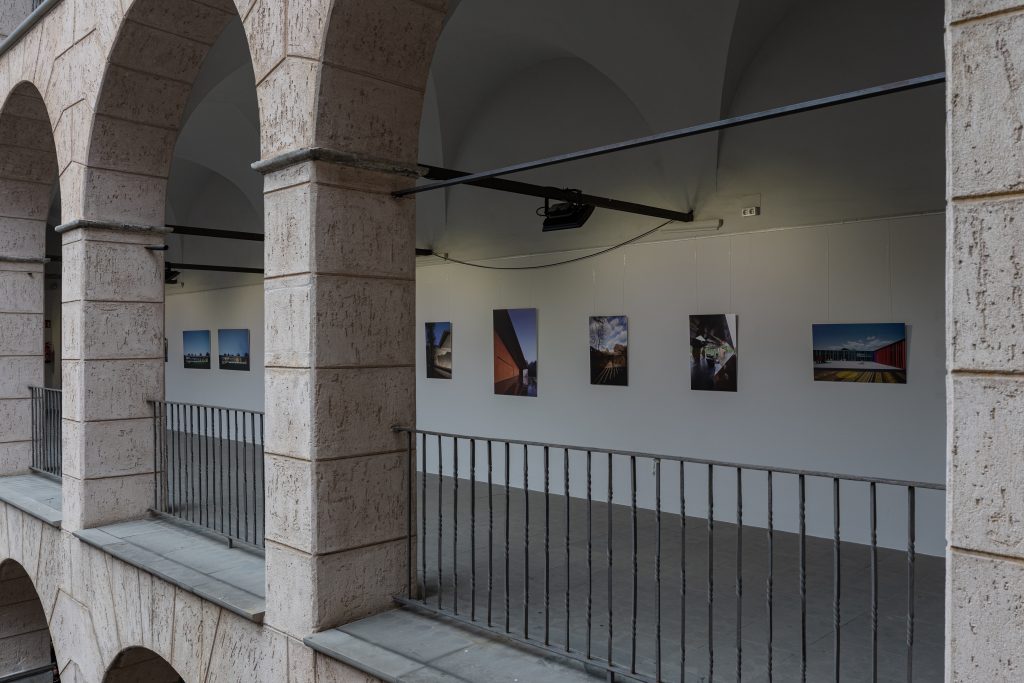
On the first floor, a selection of photographs by authors with whom they have collaborated over the years: Pep Sau, Marc Checinski, and Eugeni Pons. In the cloister, a display of sketches and reflections on their work.
The Photographers and RCR arquitectes
Photography is perhaps the most important medium for recording architecture once it has been completed. When it is not possible to have a direct experience of an architectural work, the photographer selects its most important viewpoints, explaining and interpreting it to create a lasting image. Among the photographers who have worked with RCR Arquitectes’ oeuvre, five stand out: Enric Roca Sadurní, the photographer of the studio’s early years; Eugeni Pons, who captured the first major works; Hisao Suzuki, whose distinctive vision defines the studio’s most well-known period; Pep Sau, the photographer from La Garrotxa who roots their work in the landscape he knows so well; and Marc Checinski, who contributes his expressive and singular vision. Hisao Suzuki’s vision is present throughout the exhibition. Enric Roca represents the first stage. In this cloister, there are works by Pep Sau, Marc Checinski, and Eugeni Pons, each in their own way exploring the relationship of photography through RCR Arquitectes’ work, conceived for and from its place. This exhibition emphasises photography as a singular medium and acknowledges the contributions of all these professionals, who are so important to the dissemination of RCR Arquitectes’ work.
Pep Sau (Olot, 1963-2024)
Pep Sau, a native of La Garrotxa, was a photographer as brilliant as he was modest. His work—recognised, exhibited, and awarded—takes the landscape as its foundation. He was a deeply atmospheric photographer whose work, rich in meaning and symbolism, is only just beginning to be explored. As an architectural photographer, Pep Sau worked with these same principles, blending architecture with the nature of the place where it stands and veiling it to express that relationship through elements such as wind, fog, direct sunlight, humidity, reflections, and the light of the golden hour. The photographer delved into the relationship between RCR’s architecture and its setting, photographing it at different times of day, seasons, and weather conditions, returning to it constantly to portray it as if, as the architecture scholar Josep Maria Montaner suggests, it was a clock expressing itself through the passage of time.
Eugeni Pons (Barcelona, 1964)
Eugeni Pons graduated in Philosophy from the Autonomous University of Barcelona. His studies at the Institute of Photographic Studies of Catalonia led him to become a professional photographer. Focused on architecture since 1995, he introduced a series of emerging studios in major European architecture magazines. RCR Arquitectes was one of these studios. Eugeni Pons photographs buildings from the inside out, from the inhabited space, with impeccable, measured, and refined framing. The depth of field in his photographs allows him to establish a relationship with the landscape, which, from this central position, becomes integrated into the inhabited space. When confronted with the work of RCR Arquitectes, the transparency of their interventions—often featuring a central space that is empty and open to the elements—situates the constructions within their setting, merging architecture with the landscape in panoramic compositions. When he enters the interiors of the houses, he reveals how they are traversed by light and the elements, how textures create layers of depth, and how the work becomes an interior with the condition of an exterior. It is his vision that enabled some of the studio’s first major projects, such as the Bathing Pavilion or some of the houses from the White Period, to gain visibility and a first wave of global recognition.
Marc Checinski (París, 1959)
Marc Checinski, architect and photographer, has developed a highly personal trajectory based on a distinctly expressionist photography that understands architecture as a formal exploration in all its dimensions—from volumes expressed through steep, dramatic angles to textures so strongly contrasted that they exist only as black-and-white samples without shadow. Time is embedded in the moment of taking the photograph, expressed through lighting conditions encountered by chance—direct sunlight, nighttime illumination, twilight—capturing the moment even when the building is still under construction. The dialogue between the tectonic forms of construction and the informal elements of the landscape—earth, vegetation—together with the incorporation of atmosphere, produces images that, rather than canonically explaining architecture, transform it into a memorable event that leaves a lasting impression. The photographer’s relationship with RCR Arquitectes goes back a long way. His was the vision that formed the basis of “Destellos,” the proposal that shaped the 2012 Spanish Architecture Biennial, curated by Rafael Aranda, Carme Pigem, and Ramon Vilalta. Other projects by the studio, such as the Tossols Basil athletics track, the Soulages Museum, and the recent Île Seguin, have passed through his lens. His vision continues to accompany the architects to this day.
Cloister - Sketches and Reflections
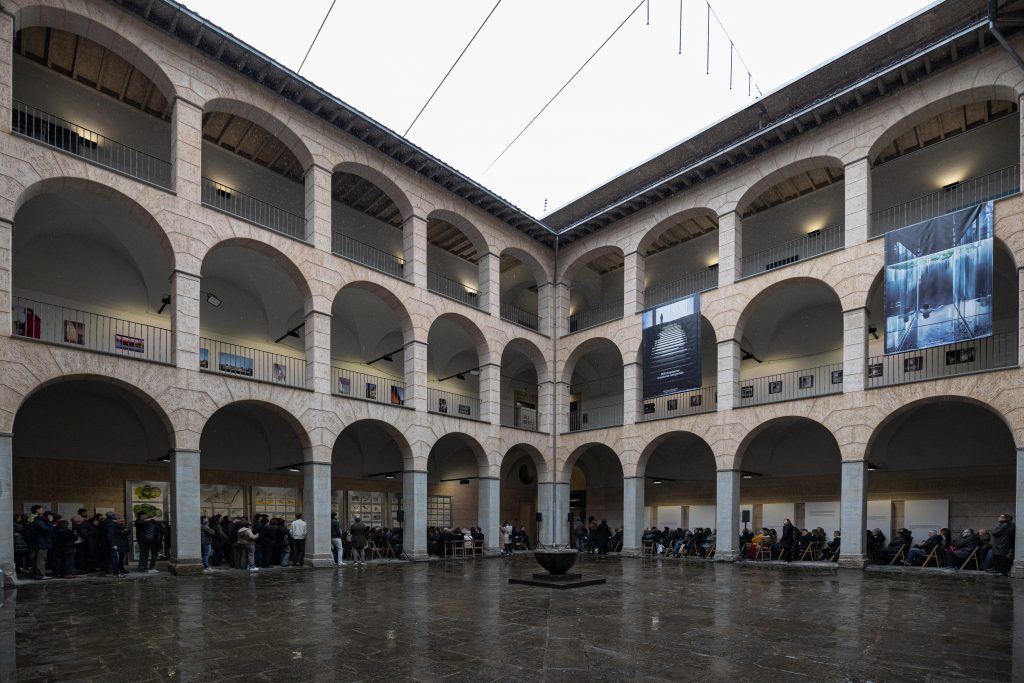
In the cloister, an exhibition of sketches and reflections on his work.
Sketches
Wash drawings are one of the means of expression of RCR Arquitectes. Agile, effective, and versatile, they test project ideas, evoke their atmosphere, and have become the most recognisable feature of their working process from the very beginning to today.
Panels
“The works of Aranda, Pigem and Vilalta (…) are like crystallisations of geology itself; they emerge from the ground but have no organic pretensions.”
C. Martí, 2003. “Crystallisations”
“In their architecture, the members of the RCR team seek these filtering effects of light, air, views and, in general, elements and atmospheric phenomena, emulating mineral and vegetal nature.”
J. A. Cortés, 2007. “The Attributes of Nature”
”Their works refer, in an unequivocal way, to the idea of monument. Since the monumental has nothing to do with size (…), but with recognizability and the sense of form.”
C. Martí, 2003. “Crystallisations”
“RCR’s sketches and watercolours express what cannot be conveyed with words and what still has no form—what expresses an intention.”
J. M. Montaner, 2012. “RCR Universe”
“It can be stated that RCR understand architecture as a mediation between human beings and nature, as a device to transmit to those who perceive and inhabit this architecture the attributes and values of the natural world.”
J. A. Cortés, 2007. “The Attributes of Nature”
“We are faced with the work of true masters in shaping architectural form, who understand the implications and roots of each of the geometries they employ.”
J. M. Montaner, 1994. “Rigour and Expression of Form”
“In this philosophy of RCR, there is a permanent demand: to relearn how to live.”
J. M. Montaner, 2012. “RCR Universe”
“Their relationship with landscape, environment and nature is deeply rooted in a cosmic vision characteristic of artists of Catalan culture (…) they make the essence of the place visible and place it at people’s disposal, making its reading possible for anyone who experiences it.”
V. Moimas, 2023. “L’architecture de RCR, une architecture-épiphanie”
“Beautiful in themselves, [RCR’s buildings] interact with their natural or artificial surroundings. Like abstract sculptures that cut through space, they activate the latent forces of their site.
(…) These architects explore a whole spectrum of values between the rural and the technological, between the natural and the artificial.”
W. JR Curtis, 2004. “Between Abstraction and Nature”
“In some cases, RCR’s practice is almost reduced to leaving things as they are.”
P. Ursprung, 2024. “Vulcano’s Workshop”
“The primary value granted to emptiness confirms that RCR aspire to timelessness: for this reason, the influences they receive are never immediate or literal, but are filtered through an abstract and universal thinking that transcends them.”
C. Martí, 2003. “Crystallisations”
“(…) There is a sense of a conscious playful element, a will to play, which injects them with inventive energy (…), without giving the impression of repetition or routine.”
J. Pallasmaa, 2017. “Meaning in Abstraction”
“The essence of RCR’s architectural knowledge lies in the ability to look and observe, to interpret and create from their landscape of La Garrotxa. This has given them the tools to understand and create anywhere: natural or rural, urban or metropolitan.”
J. M. Montaner, 2012. “RCR Universe”
“Imagine a lighthouse that is not a tower!”
P. Ursprung, 2024. “Vulcano’s Workshop”
Sala Oberta 1 - RCR, Now
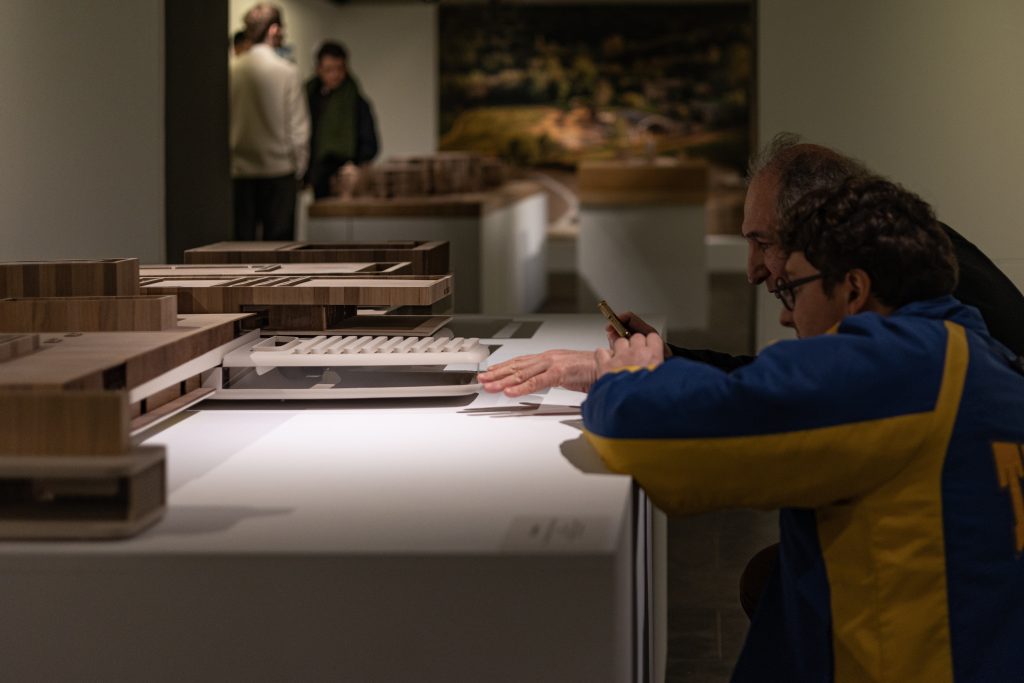
RCR, now: Sala Oberta 1 illustrates the current direction of RCR’s architecture, the studio’s post-Pritzker work, and their most recent projects, such as Muraba Veil, a residential tower in Dubai; a complex of residential towers in Tirana (Albania); the extension of the Soulages Museum in Rodez, which reflects on museum architecture; the expansion of Sants Station, shaping one of Barcelona’s main gateways; and the development of RCR La Vila. The Centre for Research and Spatial Experience is conceived as a meeting place for diverse disciplines to address contemporary challenges from an integrated and cross-disciplinary perspective, among other initiatives.
RCR, Now
From Olot to the world. RCR Arquitectes is currently an architecture studio operating in several countries across four continents. Its recent work extends from the outskirts of Olot to Mexico and Taiwan, encompassing a wide range of programs at all scales of intervention, from product design to urban fragments.
To meet these challenges, the RCR Arquitectes team has progressively expanded. Gemma Puigvert, Marta Subirós, Gilles Trégouët, Ângela Moura, Verónica Vitoriano, Noèlia Baldayo, Idurre García, Andrea Buchner, and Mar Novell form its core.
RCR Arquitectes continues to work on the same themes, with the same attitude toward place and the same love and passion for beauty as in its beginnings.
RCR Team and Awards
Honorary Members of the Official College of Architects of Cádiz, 2025
Honorary Doctorates from the National University of Córdoba (UNC), Argentina, 2025
Membres étrangers de l’Académie d’Architecture Française, 2019
Gold Medal of the Government of Catalonia, 2018
Medal of the City of Olot, 2017
Médaille d’Or de l’Académie d’Architecture Française, 2015
Officiers de l’Ordre des Arts et des Lettres de la République Française, 2014
International Fellows of the Royal Institute of British Architects (RIBA), 2012
Honorary Fellows of the American Institute of Architects (AIA), 2010
Chevaliers de l’Ordre des Arts et des Lettres de la République Française, 2008
National Award for Culture in Architecture of the Government of Catalonia, 2005
Muraba Veil Tower, Dubai
The Muraba Veil is a residential tower currently under construction in Dubai. It is conceived as a structure in which single-family dwellings of varying sizes are stacked, each with a garden terrace that filters its relationship with the exterior.
This system forms a screen-like tower 106 meters wide, 378.5 meters high, and only 22.5 meters deep, divided into 73 floors, 131 apartments, and 3 levels of shared spaces, including restaurants, swimming pools, and sports areas. The tower’s great height requires foundations 30.76 m deep, 288,013 m³ of concrete, and 34,360 tons of steel.
This geometry allows for natural light and ventilation to reach every corner of each dwelling. The garden terraces protect and set back the glass surfaces by a few meters from the building’s outer plane, defined by the metallic veil that gives the building its name, thus creating a vibrant and evanescent volume: the world’s first tower without a façade.
Pajtoni Residences, Tirana, Albania
The complex organises 1,280 dwellings in a peripheral ring of small freestanding towers arranged on a shared podium, with a unique volumetry that traces an arc and defines heights ranging from 54 to 110 m. The connection to the ground is achieved through a landscape of passages and gardens that function as civic spaces for gathering and leisure, as well as offices and commercial areas.
The upper level of the podium becomes one of the largest landscaped roofs in Europe, defining a 1.5 km elevated civic route. The complex forms a neighbourhood with a green heart that redefines and organises its surroundings, integrating into the city with its own identity.
RCR arquitectes: what it is and what it does
RCR’s Universe of Shared Creativity
RCR is an integrative project with origins in architecture but not limited to that discipline, incorporating landscape, design, art, and thought… It is also a cross-disciplinary laboratory for ideas and a cultural space.
The strength of RCR’s architecture lies in its ability to transcend its roots through a universal language, the result of a deep search for what is essential. This essence emerges, for RCR’s founders —Rafael Aranda, Carme Pigem and Ramon Vilalta— from the search for emptiness, from a dialogue between place and architecture, and, at the same time, from a creative dialogue, as in jazz, where the “I” is replaced by the “we.”
This architecture, born of shared creativity, encompasses values and relational processes in every sense. It is through this logic that it goes beyond the discipline itself and establishes a holistic vision that extends beyond architecture and any other discipline: life. Starting from life, it explores the idea that dreams are possible.
This vision was awarded the 2017 Pritzker Prize, considered the Nobel Prize of Architecture.
1 A New Cosmology
More than ever, the construction of a new cosmology is needed—new narratives in which the value of life, in all its forms, becomes paramount, and in which an awareness of interdependence embraces us, making it possible for the Earth to meet the essential needs of all living beings.
2 Roots and Wings in an Uncertain World
Very early on, we embraced the belief in having both roots and wings—or, in other words, acting locally while thinking globally.
We come from a world of certainties that have gradually faded and become veiled throughout our life cycle. Increasing uncertainty and accelerated transformation have made us the children of a veiled society in which, as predetermination has blurred, space has opened for the wisdom of uncertainty, the richness of diversity, permeability, dynamism, porosity, immateriality…
3 Everything Is Insubstantial
For a long time, there has been an attempt to understand the world in terms of primary substances. However, as knowledge advances, it increasingly seems that the world is not something that “is,” but rather a manifestation of relationships and events.
Elementary particles are not solid pieces, but brief manifestations of an energy field in which everything is changing and insubstantial. Thus, objects, plants, animals, and people are momentary interactions in which a slight balance is maintained before dissolving back into nothingness.
4 “Reality” Is the Present of Personal Perception
The world no longer admits a single, global vision. It is a world of perspectives, manifestations, and entities without defined properties. It is a world of events in which objects exist only in relation to one another.
We must learn to live with this new complexity, to embrace it, and to face the diversity of perspectives with respect and humility, understanding that “reality” is the present of personal perception.
5 Relational Architecture
Relational architecture—rooted in place, more dematerialised and dynamic than ever, with existing solid boundaries on the one hand and, on the other, boundaries that dissolve to establish continuity with the surroundings—creates atmospheres of beauty and physical and spiritual well-being.
Within it, nature, trees, flowers, colours, scents, movements, sounds, and projected shadows are essential, introducing changes into spaces through a complex interplay of relationships that leads us toward a more living architecture..
6 Dynamic Beauty
Beauty shifts its paradigm to find delight in dynamism and in the perception of the whole body, not only in vision.
The aesthetic experience no longer seeks to be that of an immobile, pristine, finished, and lifeless work, but rather one that reveals life—human, animal, or vegetal activity. Enjoyment lies in the processual and relational experience of what is happening.
7 People as Co-creators of Reality
More than ever, people are part of the dynamics of relationships that create events in space—not as spectators, but as active agents. Architecture hosts unique experiences within the personal experience of the moment.
8 The Veiled Society
We are entering a new “veiled” society in which the liquid one, transforming together with the air, has given way to its diversity and the richness of its different nuances. We now live enveloped in veiled and evanescent clouds and mists. Now, more than ever, air and water—essential for life—complement each other and generate more constant mists.
Facts and things no longer present themselves with clear contours. Not everything is black or white: complexity prevails and opens the way to constant change.
At RCR La Vila, the veiled community senses and intuits—within the mists that dissolve certainties, within the contours of forms and reality, within concepts and values—to continue moving forward in the search for a better world. Amid the haze, nothing is meant to be concluded, only spaces for imagination to be opened. We are living in a time full of contradictions, with permanently overlapping crises—a time of birth, bringing forth a new reality.
We have gathered in Bianya to share.
If we share the RCR La Vila project with passion and love, we will create beauty, well-being, and smiles for everyone.
In this time, between the wonder and the bewilderment of the world, this space must serve as a refuge to foster new relationships of freedom and creativity, and to feel that it has been worthwhile.
Rafael, Carme and Ramon
RCR La Vila: what it is and what it does
RCR La Vila is a cross-disciplinary project that promotes creativity, sustainability, inclusion, and beauty, conceived to enrich people holistically.
It is a space for experience and reflection, from which new ways of looking at the world are proposed and grounded in direct, concrete approaches arising from the dialogue between nature and architecture. In an environment designed by RCR Arquitectes, a more human and integrated vision of reality is sought, enriched by its relationships with science, the arts, and the economy, to generate a new humanism.
RCR La Vila acts as a driving force for social, cultural and territorial dynamism. It aims to contribute to improving society, making it fairer and promoting processes of transformation, with special attention to new generations.
RCR La Vila, where “dreams are possible,” is a place where, simultaneously, inspiring stays, meetings of multidisciplinary teams, training activities, shared experiences, debates, exhibitions, presentations and digital experiences can take place… in combination with the programs generated by RCR La Vila itself, as well as hosting other programs and activities that seek, in this space, a unique experience and coexistence.
Press Room
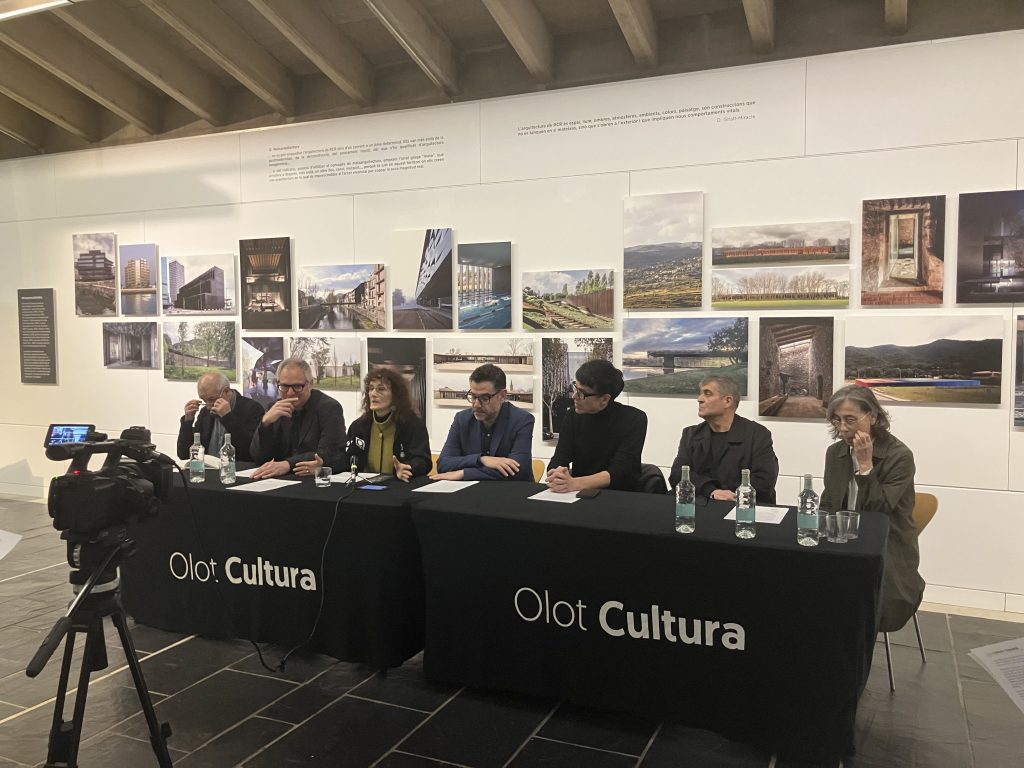
Press conference at the Museu de la Garrotxa, March 13, 2026.
At the table, from left to right: Ramon Vilalta, Jaume Prat, Montserrat Mallol, Josep Quintana, Jordi Sellas, Rafael Aranda and Carme Pigem.
- Rafael Aranda, Carme Pigem and Ramon Vilalta, founders of RCR arquitectes
Montserrat Mallol, director of the Museu de la Garrotxa
Josep Quintana, councillor for Culture and Education of the Olot City Council
Jordi Sellas, president of RCR Bunka Fundació Privada
Jaume Prat, curator of the exhibition